

This is a quick review of the Askar SQA106 telescope sold in the UK by 365 Astronomy. I had previously tested the smaller brothers of this scope, the SQA55 & SQA85 and found them to be pin sharp across the field and in perfect keeping with the spot diagrams provided by the manufacturer, I was therefore keen to test the larger SQA106 to see if it was able to deliver the same excellent results.
Unpacking
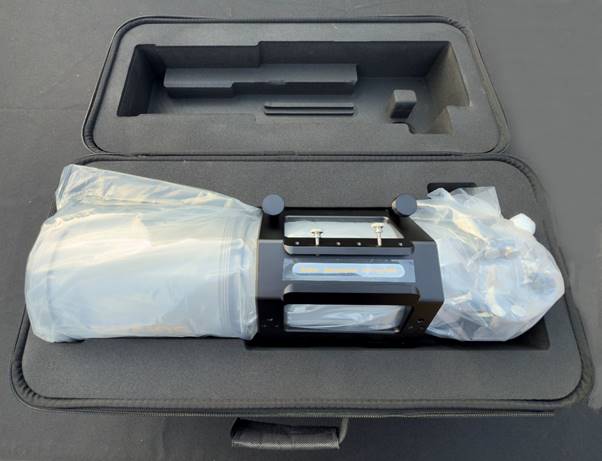
On opening the outer box, I was greeted by a smart cloth case which when unzipped revealed a very impressive telescope cocooned in a black tube ring the case has many pre-cut outs to allow fitting of additional accessories The case also has a small cut out to accommodate a ZWO EAF motor focuser if you decided to fit one, a nice touch, finally the Askar SQA106 telescope uses the larger Losmandy dovetail bar for fitting to a suitable mount.
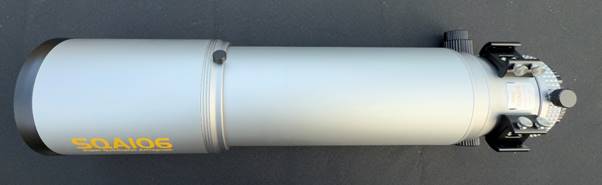
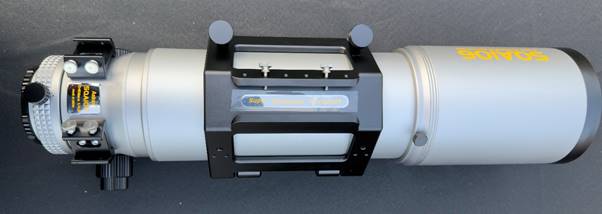
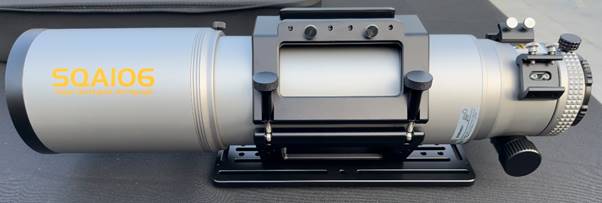
The scope tube itself has a retractable dew shield which can be easily locked in place, 2 finder shoes are provided at the rear and the focuser is a dual speed version that proved to be smooth and precise in use with no apparent flexure noted. Finally, there is a rotator with graduations which again is smooth in use and is lockable. The telescope itself is of the Petzval design and is classed as a Quintuplet Astrograph. Customers are advised to visit 365 Astronomy’s web page for this telescope where detailed information, along with many more pictures, are provided.
Testing
For the test I put the Askar SQA106 telescope on my ZWO AM5N strain wave mount which was perfectly able to support its weight which with tube rings is around 8Kg. Imaging was done with my ZWO 2600MC-Air camera which has the built in Asiair system and dual imaging and guide sensors. Back focus is not an issue with these scopes and the camera can be placed between 40 & 70mm with a recommended ideal of 55mm. I used adapters that I have to fit the camera at around 55mm which included a filter drawer. Unlike the SQA55 there is no provision to fit a filter hence the use of the filter drawer. There is only a limited travel on the focuser, but focus was achieved when the drawtube was about halfway out.
For the test I used an Optolong L-Extreme 2” filter which I have used extensively for testing with other telescopes and have found it to be very effective in my Bortle 5 skies. The camera was linked to the mount and controlled by the Asiair app via my Apple IPad Pro, set to Station mode.
I set the focal length in the app at the stated 509mm but when attempting polar alignment the system failed. I reset it to the recommended 0 focal length so that the plate solving can calculate the correct focal length which turned out to be 508mm.
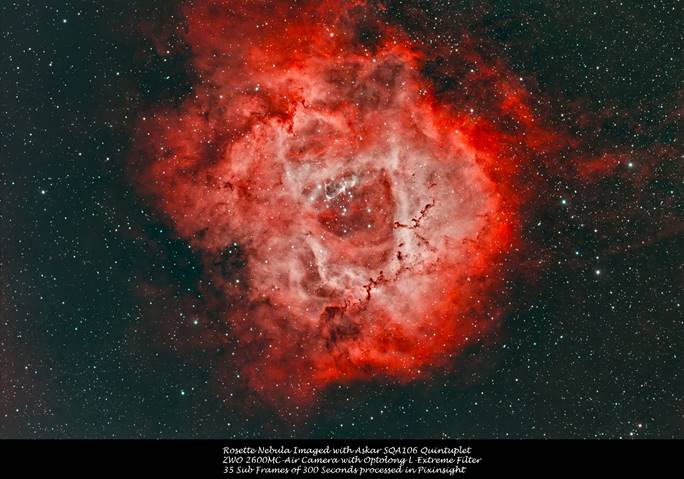
We are just entering “Galaxy Season” where the many nebulous extended objects of the Winter sky, which are perfect targets for short focus telescopes, such as the SQA106, have largely passed out of view. I had a small window of opportunity to image the Rosette Nebula, NGC 2238, which was rapidly fading into the low Western sky. Over 2 nights this gave me 35 sub exposures of 5 minutes duration cooled to -10 below ambient temperature. These were later processed in Pixinsight software, and the image is presented below.
Conclusion
This is a very fine telescope and was an absolute pleasure to image with. I have owned and used Sharpstar/Askar scopes for several years starting with the Sharpstar 90mm triplet, then the Askar 107PHQ Quadruplet and currently the Askar 130PHQ Quadruplet, all have given excellent results.
Probably the best recommendation I can give is that after testing I have decided to keep the SQA106 for myself. There are also several informed reviews of this telescope if you search on Youtube and they all give a similar thumbs up. It’s focal length of just over 500mm means that many of our deep sky extended objects will be suitable targets.
I am looking forward to imaging those targets once they reappear in the night sky.
John Bush FRAS
Like this post? Spread the word!
Posted on April 29th, 2025.