
Solar Astronomy
This is a sample report from our solar specialist colleague, John, who would test every Daystar Quark and Scout that we receive. If the product is not good enough, we will send it back to Daystar for replacement.
“On 28th September 2024 I tested, for 365Astronomy, a recently stocked Daystar Solar Scout (model SS60-DS).
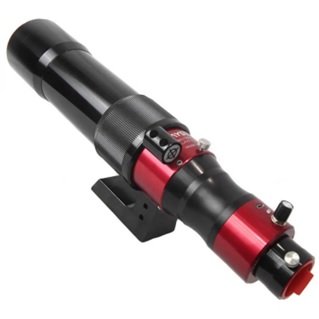
The scout is an “All in one telescope” of 60mm aperture with a built in Quark Chromosphere eyepiece. I have tested several of these in the past and have noticed that they can vary considerably in performance.
I placed the Scout on my Skywatcher “Solar Quest” mount that automatically tracks the Sun, power to the Scout was with a small power bank. The Scout came on band in about 10 minutes with the LED light showing a steady green.
I used a good quality 1.25” diagonal mirror and a 32mm Plossl eyepiece for viewing.
I also used a 1.25” IR/UV blocking filter on the nose of the diagonal as recommended by Daystar.
The view through the Scout, which showed the whole disk, was nice and bright and showed Chromosphere detail and prominences on the edge.
I then removed the diagonal and added a ZWO 174mm camera and a tilting unit; to eliminate Newton rings, this was linked to a laptop using Sharpcap Pro software. The Scout showed an evenly illuminated field with good detail, but the rotary focuser was stiff and obtaining fine detail was difficult. I have found this with other Solar Scouts in the past, but the mechanism is likely to improve with use. I took a 30 second video and a “Solar Flat”.
The use of a Solar flat is an absolute must with these limited field Quarks and helps to remove uneven illumination and any dust bunnies that are present. I used a Daystar “Flat Cap” device over the telescope objective to take the flat, these are stocked by 365Astronomy in various sizes should you want to buy one, although there are other methods available if you do not have that product
I processed the video in Autostakert software stacking 10% of the frames captured, the result is shown below.
Image after processing in Autostackert:

You can see that the Solar Flat has helped to create an evenly illuminated field and it also removed a couple of dust particles that were present.
The amount of detail present made me decide to see what additional processing could achieve. I used “Pixinsight” for processing along with the latest version of Photoshop.
The image below shows what is possible after processing.
Image after further processing in PIXINSIGHT:

Conclusion:
This is an excellent example of the Solar Scout and shows that it can be used both visually and for imaging purposes. The amount of Chromosphere detail is good and shows several prominences. It is likely that the use of a different camera, such as the ZWO 432mm would allow the whole disk to be imaged at once. I did not, however, have time to test it with that camera.
The telescope element used is a budget 60mm achromat doublet and the Quark element we understand uses, for its etalon, parts left over after cutting etalons for the premium range of Quarks, this helps to keep costs down.
The Scout is labelled as a DS which stands for Double Stack. Generally speaking, dedicated Solar telescopes, such as the Lunt range, achieve a band width of around 0.7 which is a good compromise between surface detail and prominences (Prominences can be viewed at a bandwidth of 1). Those Lunt telescopes are described as “Single Stack”. By adding a second etalon they achieve a band width of 0.5 and are described as being Double Stack telescopes.
The Solar Scout, along with others in the Quark range of products, are considered to have a band width of 0.5 and are described as Double stack.
This telescope, priced at under £1000, would make an excellent budget entry into Solar narrowband imaging, a field where equipment is priced in the thousands rather than hundreds.
To give a comparison the Lunt 60mm double stack telescope would set you back over £5000.
The Solar Scout cannot obviously compete but it still makes an excellent starter Solar telescope.
John Bush
365Astronomy Solar Specialist”
Like this post? Spread the word!
Posted on October 1st, 2024.