

Review of Baader Sundancer II

One of the advantages of working for 365 Astronomy is that I get to try out new products and, being a Solar specialist, I was intrigued when the Baader Sundancer II appeared. I already own, and use, a similar type of product in the Daystar Quark Chromosphere so was interested to see what something costing nearly 3 times as much would give you.
First up the Baader comes in a small plastic padded case with compartments for each of the components, whereas the Quark comes in a cardboard box with the unit inside a plastic screw type “bottle”, both have suitable mains power plugs included although you can also use 12V powerpacks.
The Quark can be used in refractor scopes up to an aperture of 120mm without using an ERF (Energy Rejection Filter) these being designed to go over the objective lens for larger scopes and for SCT’s, Reflectors and Maksutov’s, and these can be quite costly as they often must be custom made. For the Quark up to that 120mm you just need a UV/IR blocking filter placed in the imaging train, just before the Quark.
Reading the extensive manual for the Sundancer II I found that it can only be used up to 80mm aperture without an ERF, so this is something to consider before purchase.
The Quark has a built in telecentric barlow lens of 4.3x and is designed to perform at F24 to
F30 so was perfect with the scopes that I use, of 66mm and 90mm aperture, & working at F5.9. The Sundancer II has a similar telecentric barlow but only of 3x and is recommended to be used with F10 systems to achieve F30. The manual states that it can be used with scopes down to F8 which would put it in the same range as the Quark i.e., F24.
I do not have an F10 scope, but luckily the manual covers this for owners of faster systems (like my F5.9) it recommends stopping down the objective to achieve at least F8.
Using my William Optics ZS66mm I applied an aperture stop down to 50mm to achieve the required F8.
The Quark is a stand-alone unit that accepts a micro-USB input for power and initially there is only an orange-coloured light which turns green after about 10 minutes as the etalon heats up and the Quark comes “On Band”. There is also a rotary knob to adjust the doppler to follow features moving towards or away from the observer.
The Sundancer II is a similar eyepiece size unit, again with a rotary knob and this is linked to a separate unit which has a display. This allows a much greater degree of fine tuning, along with the rotary knob, than the Quark, although due to time constraints I did not test this. I powered the Sundancer II with the supplied mains adapter and was pleased to see it reach the desired Ha wavelength much quicker than I have seen with my Quark. The display flashes numbers during the setup and when it registers 0 it is “On band”
I set up to image with my ZWO 174mm camera and I always include a ZWO tilting unit to take care of Newtons Rings. Imaging software was Sharpcap 4 Pro. First impressions of the image on my laptop screen were disappointing with apparent uneven illumination caused by the larger field of view that the 3X barlow gave, however I know that by taking Solar Flats I can remove this.
I took a couple of 30 second SER video files with Sharpcap and a Solar flat.
These were later processed in Autostakkert and wavelength sharpened in Registax and finally enhanced in Photoshop.
Conclusions:
The image produced was highly detailed centered around an evolving sunspot group AR2976 and the solar flat removed any trace of uneven illumination. I have yet to give it a comparative test against my Quark on the same feature, but it certainly produces impressive results. Watch out for a comparative test.

Additional Report 3rd April 2022
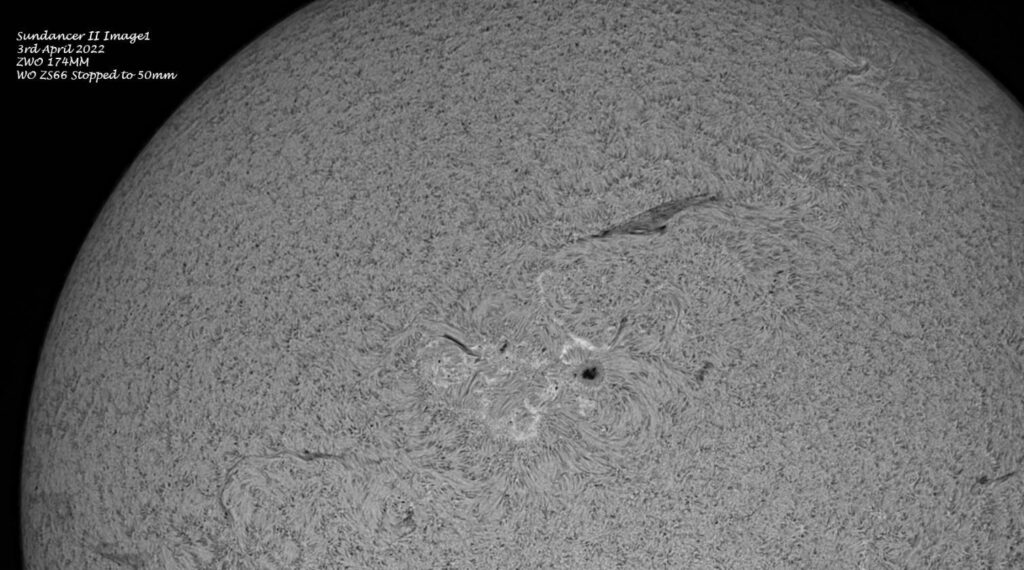
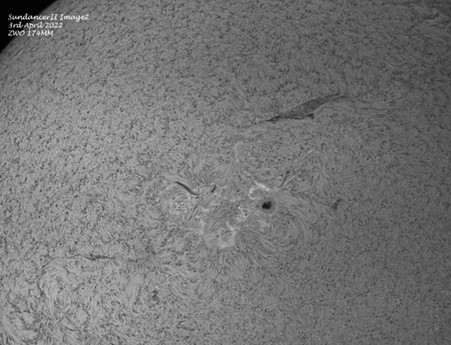
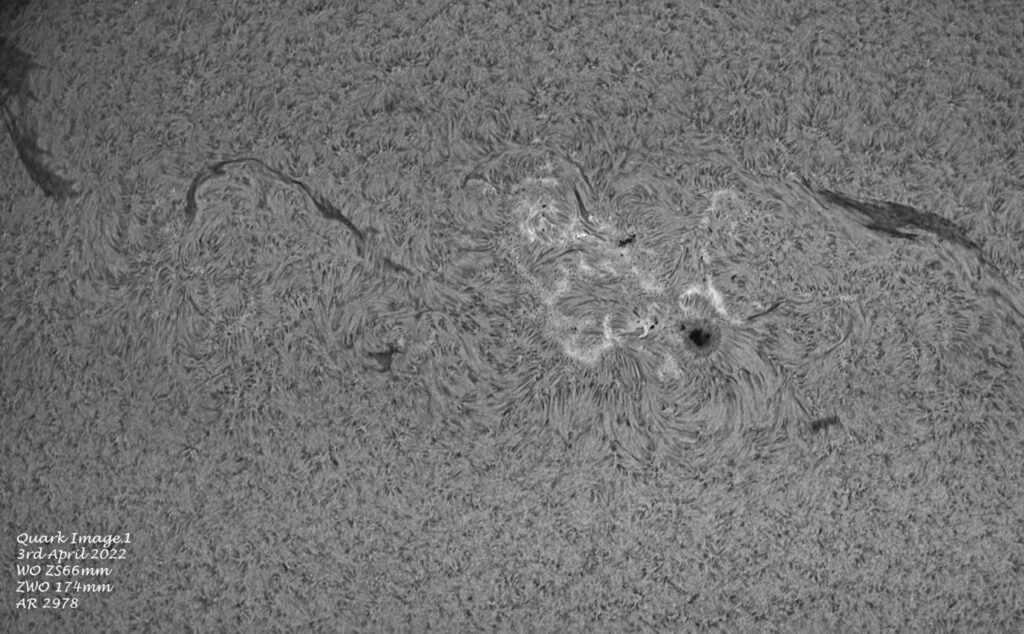
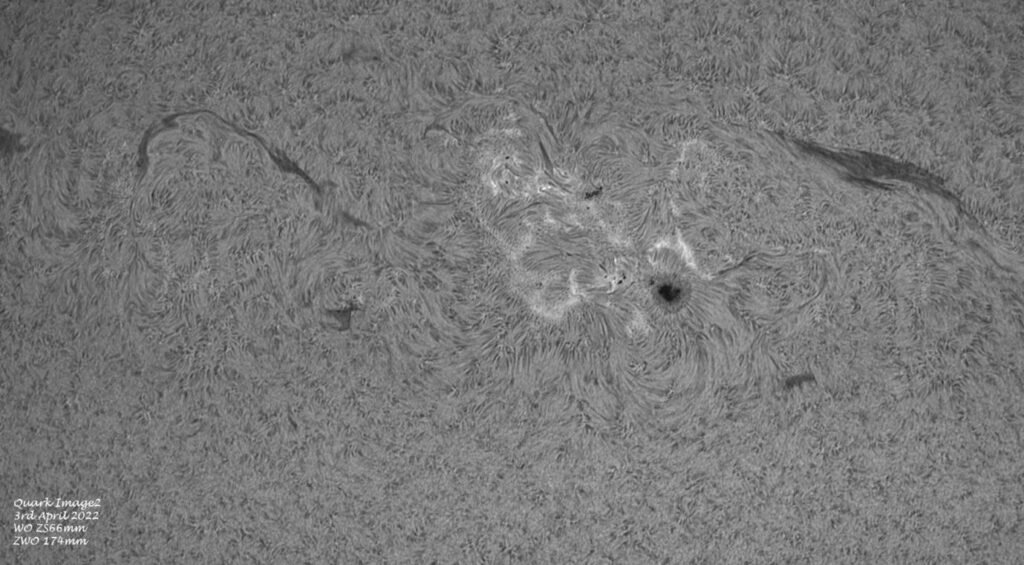
On the 3rd of April 2022 conditions allowed me to test the Baader Sundancer II against my Daystar Chromosphere Quark. From extensive testing in the past, I found that there was a little variability in the earlier range of Quarks with some not as good as others. I picked my Quark as being the best at the time and it is the one that I use to make comparisons against later models, so a test would allow customers to see what, if any, differences the two produce.
I used the same WO ZS66mm stopped down to 50mm for the Sundancer II and the same scope at full aperture for the Quark.
Active region 2978 on the Sun included an evolving sunspot and was surrounded by large filaments and I was able to start out with a largely clear blue sky. I imaged with the
Sundancer II first taking 30 second SER videos with my ZWO ASI 174MM camera and finished by taking a Solar Flat. The conditions had started to deteriorate by the time I got the Quark “On band” and I had to wait between passing clouds to get 30 second SER videos and finally a Solar flat.
Processing was once again in Autostakkert and wavelet sharpened in Registax and finished in Photoshop. The images were labelled Sundancer1 & 2 and Quark1 & 2
Comparison images are shown below (bear in mind that the images taken via the Quark are expected to provide more detail due to the larger aperture of 66mm in comparison to the stopped down 50mm aperture when the Sundancer II was used…)
Conclusion & Thoughts:
Both the Sundancer II and my Quark produced very detailed results, but due to the deteriorating conditions I was not able to test out the extensive additional controls offered by the Sundancer II. It came on band very quickly and allowed imaging within 2 or 3 minutes, the Quark taking at least 10 minutes to come on band. The Sundancer II may well be the better choice in the sort of conditions we get in the UK when small clear regions open and time is critical to make use of that. The Sundancer II needs much more specific requirements than the Quark, but should you have a suitable Energy Rejection Filter already it does offer more adjustments on both the eyepiece unit and the control box. The Sundancer II also has a wider field of view thanks to the 3X Telecentric Barlow against the 4.3X Quark, this may offer better options for users of long focal length scopes.
John Bush
365 Astronomy Ltd
Solar Specialist, Senior Astronomy Adviser
3rd April 2022
Like this post? Spread the word!
Posted on June 25th, 2024.